
In brief
- In this guide, GaaS means Generative and Agentic AI as a Service.
- Same letters, other meanings elsewhere (including Games as a Service).
- SaaS may already include automation or AI; this guide’s GaaS adds managed drafts, answers and agreed actions with approvals.
- Safety depends on provider, data handling, access controls, deployment and human review.
What GaaS means in this guide
In this guide, GaaS means Generative and Agentic AI as a Service: help using AI for drafts and answers, and help setting up AI that works toward a defined job inside tools you already use — under rules you set.
We use that label openly for two related kinds of help. It is not a claim that every “GaaS” product means the same thing, or that “Agentic AI as a Service” has one fixed abbreviation. In gaming, the same letters often mean Games as a Service. Elsewhere, writers may mean only generative access or only agent products. Always read their definition.
A wider cloud term is AI as a Service (AIaaS): delivery of AI tools and products through a cloud platform so organisations can use models and related tools without building all the local infrastructure (IBM). AIaaS is a broad umbrella. Our GaaS label sits inside that world as a practical name for generative drafting plus agentic task help — not as a synonym for every AIaaS product.
Generative AI and AI agents: what the difference is
Generative AI creates content such as text, code, images or video. Many generative products are offered through cloud APIs or applications (IBM on AIaaS and generative AI).
AI agents go further than a single prompt-and-reply. IBM describes an AI agent as a system that can perform tasks by designing workflows with available tools — including planning steps, calling external tools, and adapting as it works. Microsoft draws the same line for security: a large language model often returns content for a person to act on; an agent can invoke tools, call APIs, write data and trigger workflows.
For a business, the useful question is not the buzzword. It is what the AI may create, and what it may change — and who must approve those changes.
How this kind of AI helps businesses
Teams already use software — often with reports, workflows or AI features built in. Repeat jobs can still pile up: the same follow-up, summary or handoff between systems.
Jobs that often fit a careful first pilot:
- First replies from your own help docs or policies, with the source shown, then human review before send.
- Drafts of emails, proposals, listings or reports from your data, checked by a person.
- Preparing a lead log or ticket update for approval before anything is written.
- Short answers from your files, with a link back to the document.
- Sorting or summarising requests so a person decides what to do next.
A simple fitness test: the job happens often, the inputs are clear, and someone can check the result quickly.
GaaS beside SaaS, PaaS, IaaS and AIaaS
These labels describe different layers. They often stack.
| Model | Full form | Typical focus |
|---|---|---|
| IaaS | Infrastructure as a Service | Servers, storage, networking |
| PaaS | Platform as a Service | A place to build and run apps |
| SaaS | Software as a Service | Ready applications teams use — which may already include automation or AI |
| AIaaS | AI as a Service | Cloud access to AI models, tools and platforms (IBM) |
| GaaS (this guide) | Generative and Agentic AI as a Service | Namespace Lab’s label for generative drafts/answers plus agreed agentic steps, run with clear approvals |
SaaS example: a CRM holds customer records and may already offer automation or AI helpers.
GaaS example (this guide): we help shape AI that drafts a follow-up from those records, or prepares a field update, with a person approving before send or write.
The CRM usually stays the place records live.
For the “should we hand work over one job at a time?” angle, see Why your business should move from SaaS to GaaS.
A concept-only walkthrough (not a client story)
This is a teaching example only. It is not a Namespace Lab case study and it does not claim results.
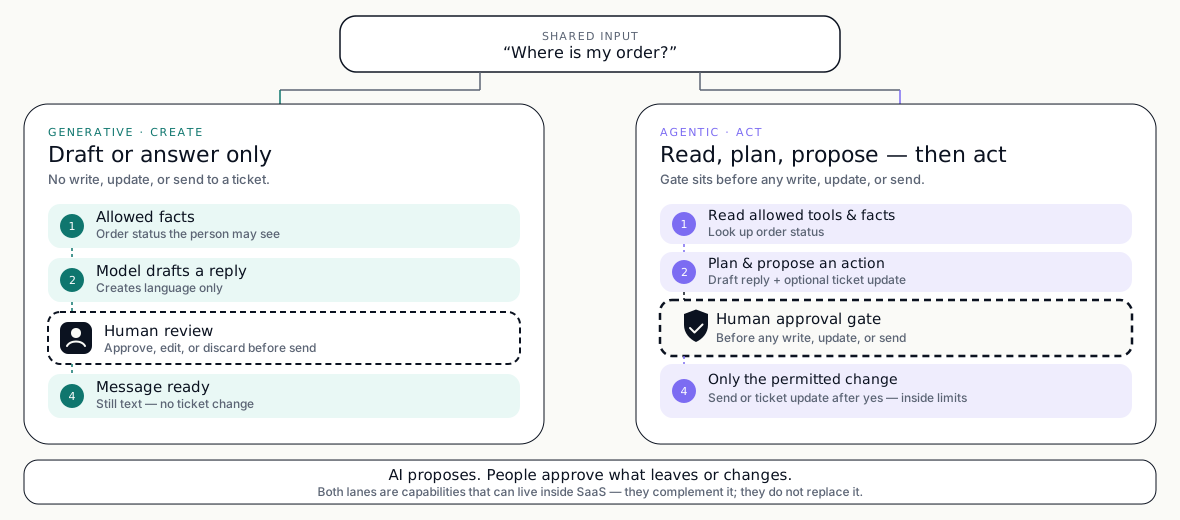
- A shopper asks, “Where is my order?”
- Your system loads only the order facts that person is allowed to see.
- Generative step: a model drafts a short reply from those facts.
- Agentic step (optional): an agent prepares a support-ticket update with the same facts.
- Human approval first: a person reviews, then the reply may be sent and the ticket may be written. Nothing is sent or written beforehand.
Useful when facts are available, the job is repeatable, and approval rules are clear. Weak when the AI invents missing facts or can change systems with no gate.
A practical pilot checklist
- Name one repeat job and what “done” looks like.
- List allowed data sources and tools — least privilege only.
- Require human approval before send, write, delete, payment or any irreversible step (Microsoft on human-in-the-loop for high-impact actions; Anthropic on confirming consequential computer-use actions).
- Decide how results are logged and who can see them.
- Run with review on. Measure accuracy, time saved and exceptions — without inventing success stories.
- Only then consider a second job.
Limits and safety
Plan for the hard parts:
- Confident mistakes. Models can invent details. Treat unverified claims as drafts.
- Data and security. Safety depends on the provider, how data is handled, access controls and how the system is deployed — not on the label “GaaS.” Microsoft notes that with agents you remain accountable for data, identity, action authorisation and human oversight (shared responsibility for AI agents). Anthropic’s computer-use guidance stresses isolation, least privilege, and asking a person before meaningful real-world consequences (Computer use tool). IBM likewise flags data privacy risk when agents connect into business systems without oversight (AI agents).
- Approvals before impact. Writes, sends and other high-impact steps wait for a person.
- Cost. Tokens, tool calls and monthly run costs can grow. Ask for clear pricing before you scale.
- Narrow scope. An agent limited to one job is easier to supervise than one that can “do anything.”
- Judgement stays human. Hiring decisions, legal sign-off and work that needs fresh judgement every time should stay with people. AI can prepare; a person decides.
What this guide’s GaaS is not
- Not a single industry-wide standard.
- Not Games as a Service.
- Not a reason to skip human review before AI output represents your business.
- Not an automatic wipe of SaaS seats — especially where that software already helps with automation or AI.
FAQ
What is GaaS?
In this guide, GaaS means Generative and Agentic AI as a Service: drafts and answers, plus agreed steps in your tools, with approval before anything is sent, written or changed.
What does GaaS stand for here?
Here it stands for Generative and Agentic AI as a Service — Namespace Lab’s label. Elsewhere the same letters may mean something else, including Games as a Service. Always check the writer’s definition.
How does this relate to SaaS?
SaaS is software your team uses, and it may already include automation or AI. In this guide, GaaS is a service approach for drafts, answers and agreed agentic steps that can work with those tools.
Is GaaS the same as AIaaS?
No. AIaaS is the broader idea of buying AI capabilities through the cloud (IBM). GaaS in this guide is our narrower label for generative plus agentic work delivered as a service.
Does this replace our CRM or other tools?
Usually no. Your CRM and other systems typically stay where records live. AI works with them under rules you set.
Is GaaS safe for customer data?
It depends on the provider, data handling, access controls and deployment. The label alone does not make a setup safe.
Will AI act without us?
Only inside limits you set. In the approach we describe, sends, record writes and other high-impact actions wait for a person’s approval.
Sources
Related reading